What are the benefits of life insurance in the UK?


Contents
The two branches of insurance are ‘general’ and ‘protection’. General insurance covers loss and damage, which includes buildings and contents, personal possessions, cars, pets and travel. Protection insurance refers to policies that are designed for financial matters, such as income protection and perhaps the most obvious example, life insurance.
The principle of life insurance is simple. It’s about risk and financial security.
- You estimate how much money your loved ones and dependants (your beneficiaries) would need if you were no longer around to support them.
- You find an insurance company that effectively promises to pay them that amount if you pass away.
- The insurance company assesses the risk of that happening and calculates how much to charge you to make that risk financially worth their while.
- The money they make from your policy is offset against the likelihood of having to pay out.
Usually, you pay for your life insurance policy with monthly payments called premiums. In some cases, you can pay quarterly, half-yearly or annually. For some policies the premiums stay the same and for others they increase each year. If you don’t keep up the premiums your policy may be cancelled and your beneficiaries won’t receive anything.
So what are the benefits of having life insurance? Everyone will have their own feelings about what makes it worthwhile, but here are 5 of the most significant ones.
1. Financial support
For many people, life insurance is the most cost-effective way of ensuring the people who depend on you will be taken care of. It can be a very important addition to any inheritance you pass on and it can be set up so there’s no tax to pay. More on this later.
Nothing can replace the personal loss if you pass away, but the financial support of a life insurance policy can prevent the grief of your loved ones from being compounded by hardship.
2. Income replacement
A regular income is one of your most important assets. The overwhelming majority of people rely on it to cover the essentials like rent and mortgage payments, energy, food, clothes, council tax and insurance, as well as paying for leisure, entertainment and holidays. It’s also the basis of your savings. Income protection is a way of ensuring a regular income if you are forced by illness or injury to stop working and can’t earn. If that income disappears for good because you pass away, life insurance is one of the best ways to fill the hole that suddenly opens up in your family’s finances.
3. Debt repayment
Debts don’t vanish if you pass away. A mortgage loan still has to be paid, and, since it’s secured on the property you bought with it, if the repayments stop, the property can be repossessed by the lender. Debts that aren’t secured, like personal loans, are just as enduring – a lender will have a claim on your estate, which means the inheritance you can pass on will be affected. A life insurance policy can yield enough money to settle those debts, leaving your home and your estate unburdened for your loved ones. Some mortgage lenders even make it a condition of their loan that you take out life insurance, even though it’s not a legal requirement. If you want your loved ones and dependants to live on debt-free and worry-free, life insurance is well worth considering.
4. Funeral costs
It’s possible to take out a separate insurance policy specifically to cover the cost of your funeral, but if you prefer not to do this you can make sure there’s enough money due from your life insurance policy to pay for it.
5. Non-financial benefits
What are the advantages of life insurance beyond the purely financial? Its value is not only in the money it promises to pay out but in the comfort and reassurance to be gained simply from having it. It lets you and those close to you lead worry-free lives, knowing that if the worst happens, they will be looked after. It’s hard to put a price on peace of mind, but a life insurance policy comes pretty close.
Some life insurance policies fulfil only one function – to pay out if you pass away. Examples of this are term, decreasing and increasing policies. Whole life policies can provide what are known as ‘living benefits’. These are ways in which your life insurance policy provides financial help while you’re alive.
Cash accumulation
Whole life policies often include an investment element, which gives the policy a cash value. This means you might be able to withdraw money or borrow against it.
Childcare and education
One of the most common reasons to withdraw money or borrow against a life insurance policy is the need to fund childcare or your children’s education, be it private school or university tuition fees. The costs can be significant, so this is a very attractive option
Loan security
If it has a cash value, you may be able to use your life insurance policy as security for a loan, giving a lender reassurance that you’re good for the money. Of course, if you’re unable to repay the loan, the lender is entitled to recoup what you owe from the policy, so that will have an impact on what your beneficiaries receive.
As we’ve explored, some life insurance policies build up a cash value, acting as a form of investment or savings. There are other uses to which you can put your life insurance.
Business uses
Life insurance is often used by business owners and members of business partnerships. For example, a key person life insurance policy can enable a business to continue trading without disruption if one of its most important personnel passes away. Life insurance can also provide funds for a business to buy back any shares owned by a deceased director or partner. An individual can also use it as a guarantee of their financial obligations to a business or partnership.
Estate planning
If you have, or expect to have, a substantial or complex estate, you may want to ensure that, when you pass away, it is distributed according to your wishes. Preparing a will is essential, but your life insurance policy can play an important part too. When you take out your policy you name your beneficiaries, but if you place it in trust you appoint trustees to supervise how the funds are paid out amongst those beneficiaries. This means any tax obligations can be minimised and your instructions are carried out to the letter.
Most of the benefits we’ve covered, such as cash value and loan security, apply to whole life insurance policies. Whole life means the policy has no fixed end date but continues for the whole of the insured’s life. There are many other policies, often with fixed end dates, which may not be as versatile but are nevertheless worth exploring. These include term life, level, decreasing, increasing, and joint life.
When you pass away, your estate passes to the people named in your will or, if you don’t have a will, according to the rules of intestacy. Currently, no inheritance tax is payable on the first £325,000 but anything above that is taxed at 40%. If the proceeds of your life insurance policy form part of your estate there’s a good chance they will be taxed. You can avoid this by placing your life insurance policy in trust. This keeps it outside your estate and means you beneficiaries will receive the money tax-free.
Not everyone needs life insurance, but those who don’t are generally the extremely wealthy or people with no family or dependants. For everyone else, it’s something that deserves serious consideration. The most obvious examples of people who might need the financial support and comfort of life insurance are:
- People with spouses or partners
- Homeowners with mortgages
- Parents of children, whether under or over 18
- Carers
- Anyone who wants to leave money to others
- People wishing to leave money to charity
What are the benefits of life insurance in the UK?
Frequently asked questions
Fact-checked and reviewed by Kiruba Shankar Eswaran or another licensed agent on our team. Read our editorial standards.
This guide is for general educational purposes and is not financial advice. Cover, eligibility and terms vary by insurer and by policy. Always read the policy documents for the full terms, limitations and exclusions before you buy.
Related resources
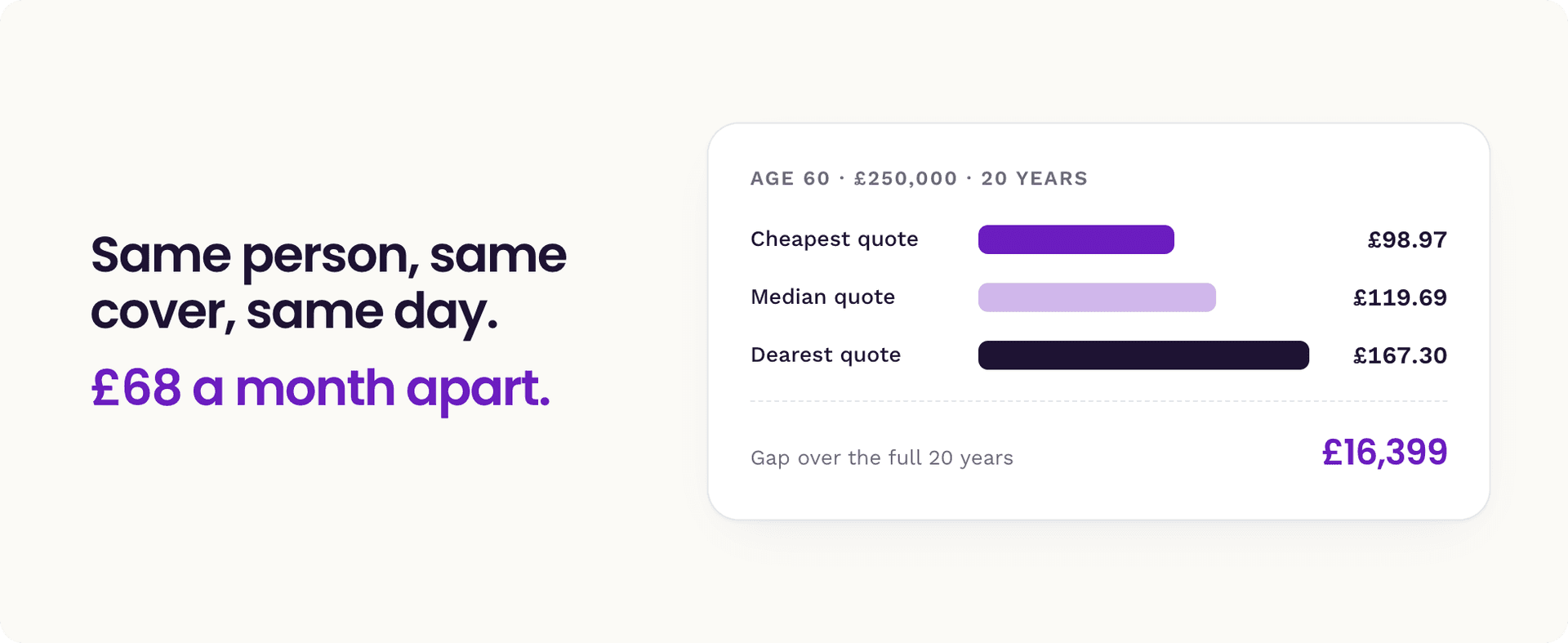
Life insurance cost UK 2026: what 6,557 real insurer quotes show
We collected 6,557 live quotes from UK life insurers in September 2026 and compared every one. Median prices by age, cover amount and policy length, how much smoking multiplies your premium, why bigger policies cost less per pound, and how mortgage protection compares with level cover.

What Is Term Life Insurance? UK Guide & Quotes (2026)
A complete UK guide to term life insurance: how it works, what it costs, the main policy types, underwriting, how it compares with whole of life, and the top UK providers.

6 Financial Resilience Tips for 2026
New Year, new money mindset. It’s time to break free from financial anxiety once and for all. Here are six simple tips to boost your financial resilience in 2026 and bring you peace of mind all year long!

Life Insurance for Young Adults
Life insurance for young adults doesn't have to be complicated or costly. This comprehensive guide covers why purchasing life insurance as a young adult locks in lower rates based on current health and how to pick the proper policy length and provider for your situation.

Turning Customer Curiosity Into Confidence: Theea's Coverage Calculator
Introducing Theea's Coverage Calculator: the intuitive insurance tool inspired by thousands of customer conversations that turns anxiety into tailored advice and confusion into confident choices.

Meet Your Newest Eleos Perks
We’re expanding our perks with two new additions designed to turn good intentions into healthy habits. Discover everything you can get for free with an Eleos policy.